

Sewing threads for mattresses
Mattresses must combine comfort, durability and reliable construction to withstand the demands of everyday use. From mattress covers and quilted surfaces to closing and topstitch seams, sewing threads play an important role in maintaining seam strength, stability and long-term performance under repeated mechanical stress.
AMANN offers a wide range of sewing threads for mattress manufacturing. Topfil in combination with Texturan is recommended for mattress production, while Topcore provides a versatile solution for closing, topstitching and quilting operations. Serafil, Rasant, Saba and Sabatex offer additional options for different sewing requirements. The appropriate sewing thread depends on the mattress construction, materials, machine type and sewing conditions.
Mattress manufacturing – from closing seams to topstitching
AMANN sewing thread recommendation for mattresses
Mattress manufacturing requires sewing threads that provide reliable seam strength, durability and consistent sewing performance. Different production processes and seam constructions place specific demands on the sewing thread, particularly when processing multilayer materials or creating closing and topstitch seams.
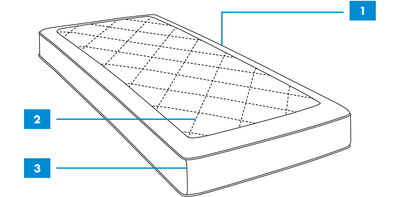
For the application shown below, AMANN recommends Topfil in combination with Texturan. Topfil Ticket 60 / Tex 45 is used as the needle thread for all three illustrated seam positions. For closing seams, Topfil is also used as the looper or bobbin thread, while Texturan Ticket 120 / Tex 18 is specified as the looper thread for the topstitch seam.
The recommended stitch types include 401 double chainstitch for closing and topstitch seams and 301 lockstitch for an additional closing seam. The corresponding thread sizes and needle sizes are specified in the technical table below.
Topcore is another specialised option for mattress and bedding manufacturing. This polyester core spun thread is suitable as both needle and looper thread for closing and topstitch seams, as well as sewing and quilting operations. Its extra-large thread carriers allow extended production runs with fewer thread changes. Topcore is available in Ticket 80 / Tex 40 and is certified according to OEKO-TEX® STANDARD 100, product class I (baby articles), appendix 6.
Depending on the mattress materials, machine type, seam construction and sewing conditions, Serafil, Rasant, Saba and Sabatex can also be considered in suitable thread sizes. The sewing thread combination should be selected according to the specific requirements of the manufacturing process.
| Seam no. | Seam type | Stitch type | Needle thread | Bobbin or looper thread | Needle size min. Nm | Needle size min. No | ||||
|---|---|---|---|---|---|---|---|---|---|---|
| Article | Ticket no. | Tex no. | Article | Ticket no. | Tex no. | |||||
| 1 | Closing seams | 401 double chainstitch | Topfil | 60 | 45 | Topfil | 60 | 45 | 130 | 16 |
| 2 | Topstitch seams | 401 double chainstitch | Topfil | 60 | 45 | Texturan | 120 | 18 | 130 | 12 |
| 3 | Closing seam | 301 lockstitch | Topfil | 60 | 45 | Topfil | 80 | 30 | 100 | 14 |
Requirements for sewing threads in mattress manufacturing
Mattress seams must withstand repeated mechanical stress while maintaining the structural integrity and comfort of the finished product. Depending on the mattress construction, materials and seam position, requirements may include:
- High seam strength
- High tear resistance
- Reliable performance under repeated mechanical stress
- High durability of closing and topstitch seams
- Consistent stitch formation
- Reliable sewing performance at industrial production speeds
- Suitability for multilayer and voluminous mattress materials
- Compatibility with different mattress fabrics and material constructions
- Reliable performance in double chainstitch and lockstitch applications
- Consistent seam quality throughout the manufacturing process
The right combination of sewing thread, thread size, stitch type, needle size and mattress material helps achieve durable seams and reliable processing throughout mattress production.
Choosing the right sewing thread for mattresses
There is no single sewing thread or thread size suitable for every mattress manufacturing process. The appropriate solution depends on several factors, including:
- Type and construction of the mattress
- Mattress cover material and fabric properties
- Material thickness and number of layers
- Expected mechanical stress and seam requirements
- Seam position and construction
- Closing or topstitch seam requirements
- Machine type and sewing conditions
- Stitch type and stitch density
- Needle and looper or bobbin thread combination
- Thread size
- Needle size
A closing seam using a 401 double chainstitch, for example, may require a different thread combination from a 301 lockstitch seam. Similarly, topstitch seams may benefit from using Topfil as the needle thread in combination with Texturan as the looper thread. Topcore offers an additional option for applications requiring a versatile sewing thread for closing, topstitching and quilting.
Sewing threads should therefore be selected according to the mattress materials, seam construction and production conditions to ensure reliable sewing performance and durable seam quality.